
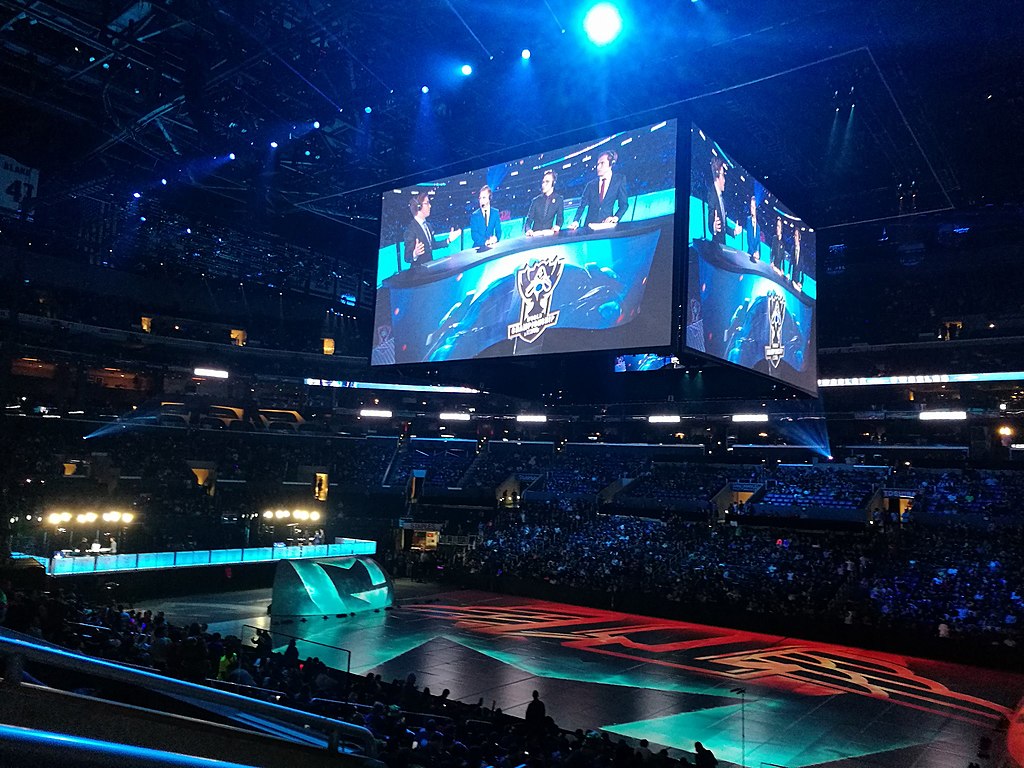
Esports. This word has not been used commonly until 2010s. Though the origin of the word can be traced back into 1970s to 1980s, when some video game competitions, such as the Space Invaders Championship held by Atari in 1980, took place but such early forms of esports were not widely appreciated by people. Even nowadays, there is an argument whether we should take esports as real “sports.” To some people, esports is considered nothing more than immature video game contest. However, to others, it is indeed considered as a form of sports, which can be enjoyed by multiple people, and create a significant amount of profits by carrying it out. Apparently, as personal computers and mobile devices are widespread to more population of the world, esports has accessibility to all those people. As people are exposed more to gaming industry and making more contact to it, people’s interest toward esports grew. In 2013, I still remember how much I was surprised when I heard that there is going to be a world-wide competition for a computer game called the League of Legends would be taking place in the Staples Center, home to the famous Los Angeles Lakers of NBA, Los Angeles Kings of NHL and so on.
My personal tie to the industry of esports dates back into early 2000s. As a child, I had suffered a syndrome called Nephrotic Syndrome, which hampered me from growing up like the other kids of my age. I spent a couple of years in ICU, and even after I was discharged, I had to be careful, try not to be exposed to environments that can give me any sort of sickness. Thus, unlike most of other kids of my age, I had to spend much of my time as a child at home. At first, watching TV was one of the options I enjoyed very much. I found a couple of channels designated for broadcasting competitions of Starcraft and Warcraft for 24-hours. Even though I knew about those games, for they have been big hits in South Korea at that time, I was not really a player of those games. However, as watching the games being played by the best players of South Korea (which later I figured out that meant they’re one of the very best of the world at that time), I found spectating video games could be very fascinating. Since then, I’ve been a big fan of esports and stayed tuned for Starcraft Leagues and League of Legends leagues.

Even though I am not quite tuned for them, the Overwatch leagues are recognized as one of the biggest esports nowadays. The league follows the model of other traditional North American professional sporting leagues by using a city-based teams, sponsored by separated ownership groups. The city of Atlanta, of course, is home for one of the professional Overwatch team, the Atlanta Reign.

As of 2019, there are two divisions of Pacific and Atlantic divisions, which consist of 20 teams, each based in a global city such as Atlanta, Toronto, and Seoul. The Overwatch league, which was founded in 2017, was so successful that ESPN reported the League achieved a lot more than its expectations and dragged big advertisers such as Toyota and T-Mobile. In 2019 season, which began on February 14th and is running through August 25th, the total prize estimates 5 million USD. The league has Coca-Cola and Bud Light as its sponsors for the season of 2019 and is being officially broadcasted to multiple countries of Europe, Americas, and Asia. The league’s commissioner, Nate Nanzer, was even nominated by the Fortune as one of their “40 under 40” in 2018, due to the enormous success of the Overwatch League.
In 2018, esports was featured at 2018 Asian Games as a demonstration sport (in demonstration sport, won medals would not be counted in). The esports competition included widely known games such as Hearthstone, League of Legends, and Starcraft II. In 2022, it was announced that esports would be a formal medal event for 2022 Asian Games (yet the Olympic Council of Asia put this initial plan to hold until esports acquires a recognized status from the world—so it is uncertain that if esports would be recognized as medal-counted like formal “sports”). Even though its uncertain status as a formal member of sports, it is undeniable that esports industry is growing rapidly. Consider what we call esports was recognized as nothing more than a video game competition just a decade ago. Like the other digital-based creations, it is and will too grow up and spread exponentially. However, because there is no clear line that separate esports from video games (and because some are believing that esports are too “silly” as a formal sport), it seems like esports will need some more time to be recognized and accepted by people to be recognized as a member of sports.

To me, watching esports is nothing different from watching a basketball game or a soccer match. But just as much as the other sports, a spectator would not very appreciate watching a game unless he knows how it works. The video-game-based esports may look silly to some of you and may be considered as for someone who is less-athletic. However, esports is suitable for more people as our lives are growing busier and more complicated, leaving us less and less time to spend being involved in “athletic” activities. I suggest the readers gently to at least give esports a try and see how it can really have impact on people’s lives.
What does sports mean to you? Does it have to be old and have a long history with people? What sets “mind-games” such as chess apart from more “classic” sports like baseball? The answers may vary. People have been very conservative and restrictive towards widening what are to be considered as a member of sports. However, I believe there would be change at some point, just as much as we are getting used to equality over race and sex. Esports really offered me, a sick boy who was incapable of physically hanging around with the world, a window to communicate with a bigger world, by watching and participating. What aspect of esports is less valuable than that of a “regular” sport? I do not have an answer for that.
Do you?
 Shawn Ha